
 By
By
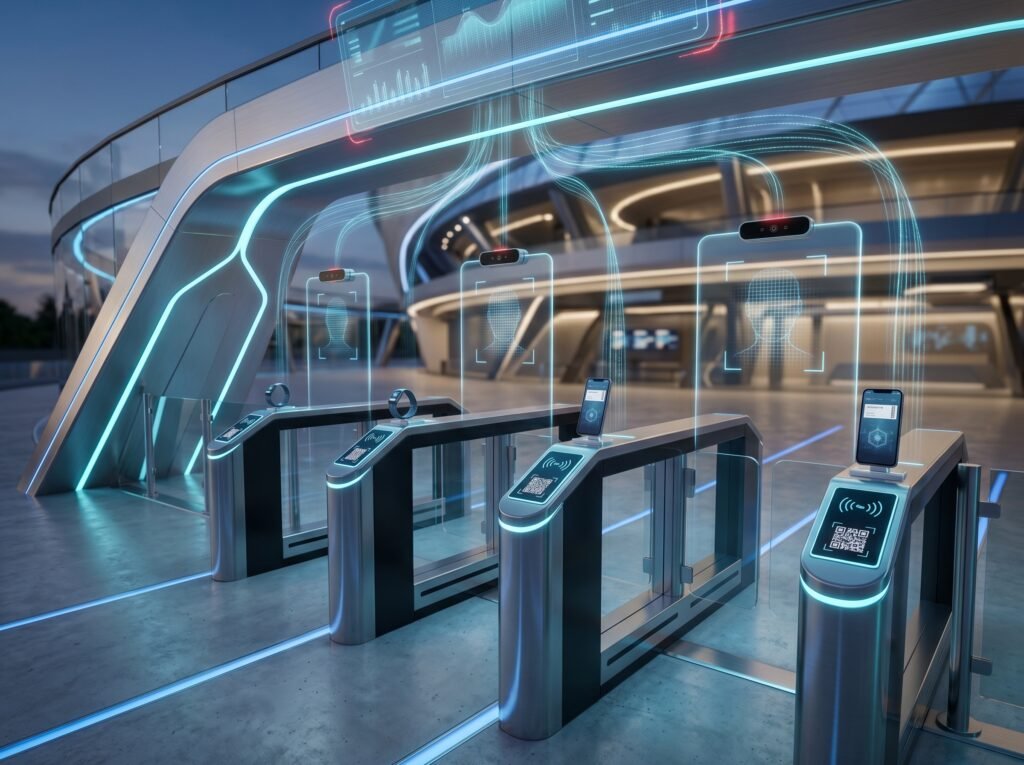
The Security and Logistics Technologies Transforming Venue Entry, Reducing Fraud, and Creating Frictionless Fan Experiences
Introduction
Anyone who has attended a major concert, sporting event, festival, convention, or live entertainment experience knows the frustration of standing in a long entry line. Whether caused by ticket verification delays, security screenings, identification checks, or crowd congestion, lengthy queues have long been considered an unavoidable part of attending large-scale events.
However, that reality is rapidly changing.
Across stadiums, arenas, convention centers, airports, and entertainment venues, a new generation of biometric authentication and smart ticketing technologies is fundamentally transforming the arrival experience. Facial recognition systems can verify identities in seconds. Near Field Communication (NFC) technology enables attendees to enter venues with a simple tap of a smartphone or wristband. Blockchain-powered ticketing platforms are helping organizers combat fraud and scalping while providing unprecedented visibility into ticket ownership and transfers.
Together, these technologies are creating what many event professionals call “frictionless entry”—a process designed to move attendees from arrival to admission as quickly and securely as possible.
The benefits extend far beyond convenience. Faster entry improves attendee satisfaction, reduces staffing requirements, strengthens security protocols, increases venue efficiency, and helps organizers gain valuable operational insights. At the same time, advances in encryption, digital identity verification, and anti-fraud systems are helping venues address some of the industry’s most persistent challenges.
This article explores how facial recognition, biometric verification, NFC ticketing, blockchain authentication, and intelligent venue infrastructure are eliminating event lines and reshaping the future of live experiences.
Why Event Lines Have Always Been a Problem
Before examining the technology, it’s important to understand why venue entry has traditionally been such a difficult logistical challenge.
Large events must process thousands—or even tens of thousands—of attendees within relatively short timeframes.
A typical stadium, festival, or conference venue may need to verify:
- Ticket authenticity
- Identity credentials
- Access permissions
- Age restrictions
- Security compliance
all while maintaining a positive attendee experience.
Historically, this process has relied heavily on manual verification.
Common bottlenecks include:
- Paper ticket inspection
- Barcode scanning delays
- Identity checks
- Security searches
- Ticket fraud investigations
- Equipment malfunctions
Even a few seconds of delay per attendee can create substantial queues when multiplied across thousands of arrivals.
For organizers, long entry lines represent more than an inconvenience. They can lead to:
- Missed opening performances
- Reduced concession sales
- Negative attendee feedback
- Security vulnerabilities
- Increased staffing costs
As events grow larger and audiences demand more seamless experiences, traditional entry methods are becoming increasingly unsustainable.
The Rise of Smart Ticketing
Smart ticketing refers to digital ticket systems that leverage modern technologies to improve security, convenience, and operational efficiency.
Unlike traditional paper tickets or basic QR codes, smart tickets can incorporate:
- NFC technology
- RFID chips
- Mobile wallet integration
- Dynamic encryption
- Blockchain verification
- Biometric authentication
These technologies allow organizers to verify attendees more quickly while reducing opportunities for fraud.
NFC Ticketing: The Tap-and-Go Revolution
One of the most widely adopted smart ticketing technologies is Near Field Communication (NFC).
NFC enables short-range wireless communication between devices.
Many attendees already use NFC daily through:
- Mobile payments
- Digital wallets
- Transit passes
- Hotel key cards
In event environments, NFC transforms smartphones and wearable devices into secure digital tickets.
How NFC Ticketing Works
When attendees arrive at a venue:
- Their ticket is stored digitally on a smartphone or wearable device.
- An NFC reader communicates with the device.
- Authentication occurs instantly.
- Access is granted within seconds.
The entire process often takes less time than scanning traditional barcodes.
Advantages of NFC Ticketing
Faster Entry Speeds
NFC readers process attendees significantly faster than manual ticket inspection methods.
This improves crowd flow and reduces congestion.
Reduced Physical Contact
Touchless entry became especially attractive following the pandemic.
Attendees simply tap a device without exchanging paper tickets.
Enhanced Security
Encrypted communication makes ticket duplication significantly more difficult.
Better User Experience
Most attendees already carry smartphones, reducing the need for printed documents.
RFID Wristbands and Wearable Access
Large festivals increasingly rely on RFID-enabled wristbands as both tickets and payment tools.
These wearable devices provide several advantages over traditional ticketing systems.
Multi-Functionality
A single RFID wristband can manage:
- Venue access
- VIP privileges
- Cashless payments
- Camping access
- Age verification
Faster Throughput
Attendees can enter venues almost instantly by tapping a wristband against a reader.
Operational Data Collection
Organizers gain valuable insights into:
- Arrival patterns
- Crowd movement
- Venue utilization
- Purchasing behavior
This data helps improve future event planning.
Facial Recognition: The Next Step in Frictionless Entry
Perhaps the most transformative development in event access technology is facial recognition.
Biometric systems eliminate the need for attendees to present physical tickets, identification cards, or mobile devices.
Instead, the attendee becomes the credential.
How Facial Recognition Check-Ins Work
The process typically involves:
Step 1: Enrollment
Attendees voluntarily upload a photo during registration.
Step 2: Identity Verification
The system confirms the attendee’s identity against official documentation.
Step 3: Venue Arrival
Cameras capture a live facial image.
Step 4: Instant Authentication
AI algorithms compare the live image against stored biometric records.
Step 5: Entry Approval
Access is granted automatically if a match is confirmed.
The entire process can take only a few seconds.
Why Venues Are Investing in Biometrics
The appeal of facial recognition extends beyond convenience.
Increased Throughput
Biometric lanes can process attendees more quickly than traditional entry systems.
Improved Security
Unlike paper tickets, facial characteristics cannot easily be transferred or duplicated.
Reduced Staffing Requirements
Automation lowers the need for manual verification personnel.
Enhanced VIP Experiences
Premium attendees can enjoy near-instant entry.
For high-capacity venues, these efficiency gains can be substantial.
AI and Facial Recognition Accuracy
Modern facial recognition systems rely heavily on artificial intelligence and machine learning.
Advanced algorithms analyze:
- Facial geometry
- Eye positioning
- Bone structure
- Unique facial landmarks
to generate biometric templates.
These systems continually improve as they process additional data.
Recent advances have significantly increased accuracy under challenging conditions such as:
- Poor lighting
- Crowd density
- Different viewing angles
- Facial coverings
This has accelerated adoption across large venues and transportation hubs.
Combating Ticket Fraud and Scalping
Ticket fraud remains one of the event industry’s most persistent challenges.
Common forms include:
- Counterfeit tickets
- Duplicate ticket sales
- Unauthorized reselling
- Identity fraud
Smart ticketing technologies are helping address these problems.
Dynamic Digital Tickets
Unlike static paper tickets, digital tickets can be updated continuously.
Features include:
- Rotating QR codes
- Real-time authentication
- Transfer restrictions
- Device binding
These mechanisms make unauthorized duplication significantly more difficult.
Blockchain Ticketing and Ownership Verification
Blockchain technology is increasingly attracting attention within the event industry.
While often associated with cryptocurrencies, blockchain’s most relevant application for events involves secure recordkeeping.
What Is Blockchain Ticketing?
Blockchain creates a permanent, tamper-resistant record of ticket ownership.
Every ticket transaction is recorded on a distributed ledger.
This enables organizers to track:
- Original issuance
- Ownership transfers
- Resale activity
- Entry validation
with complete transparency.
How Blockchain Reduces Scalping
Scalping occurs when individuals purchase large numbers of tickets and resell them at inflated prices.
Blockchain-based systems can combat this through:
Ownership Controls
Organizers can restrict unauthorized transfers.
Smart Contracts
Automated rules can regulate resale pricing.
Identity Verification
Tickets can be linked directly to verified attendees.
Transparent Audit Trails
Every transaction remains visible and traceable.
These capabilities create a more controlled ticket marketplace.
Smart Venues and Integrated Access Systems
Modern venues increasingly combine multiple technologies into unified access ecosystems.
A single attendee journey may involve:
- Digital ticket purchase
- Identity verification
- Facial recognition enrollment
- NFC credential storage
- Automated entry authentication
All managed through interconnected software platforms.
The result is a seamless experience requiring minimal intervention from staff.
Real-Time Crowd Management Benefits
Faster entry systems don’t just improve attendee satisfaction—they also improve safety.
Reduced Congestion
Shorter lines decrease crowd density near entrances.
Better Emergency Response
Real-time entry data helps security teams understand venue occupancy.
Improved Resource Allocation
Organizers can adjust staffing levels based on arrival patterns.
Enhanced Situational Awareness
Live dashboards provide operational visibility throughout the venue.
These capabilities contribute to safer and more efficient event environments.
Privacy and Ethical Considerations
Despite their advantages, biometric systems raise important privacy concerns.
Common questions include:
- How is biometric data stored?
- Who can access the information?
- How long is data retained?
- Can data be deleted?
Attendee trust is essential.
Best Practices for Responsible Deployment
Organizations adopting facial recognition should prioritize:
Transparency
Clearly explain how data will be collected and used.
Consent
Participation should be voluntary whenever possible.
Data Minimization
Collect only information necessary for authentication.
Strong Encryption
Protect stored biometric records from unauthorized access.
Compliance
Adhere to applicable privacy regulations and industry standards.
Responsible implementation is critical for maintaining public confidence.
The Future of Event Entry
The next generation of venue access technology will likely become even more seamless.
Emerging developments include:
- AI-powered digital identities
- Biometric multi-factor authentication
- Smartphone-free entry systems
- Decentralized identity verification
- Advanced behavioral analytics
- Integrated travel and event credentials
Eventually, attendees may move through venue entrances without stopping at all, as identity verification occurs automatically in the background.
The goal is simple: eliminate friction while maintaining security.
Conclusion
For decades, long entry lines have been one of the most frustrating aspects of attending live events. Today, technologies such as facial recognition, NFC ticketing, RFID wearables, blockchain authentication, and AI-powered identity verification are fundamentally changing that experience.
These innovations allow venues to process attendees more quickly, improve security, reduce fraud, combat ticket scalping, and create more enjoyable experiences from the moment guests arrive. What was once a slow and often frustrating process is becoming increasingly seamless, efficient, and intelligent.
While privacy and ethical considerations must remain central to deployment strategies, the direction of the industry is clear. As biometric systems become more accurate and digital ticketing technologies continue to evolve, the traditional event queue may eventually become a relic of the past.
For organizers, the benefits extend beyond faster entry. Smart ticketing and biometric authentication are laying the foundation for a new generation of connected venues where security, convenience, personalization, and operational efficiency work together to deliver better experiences for everyone involved.