
 By
By
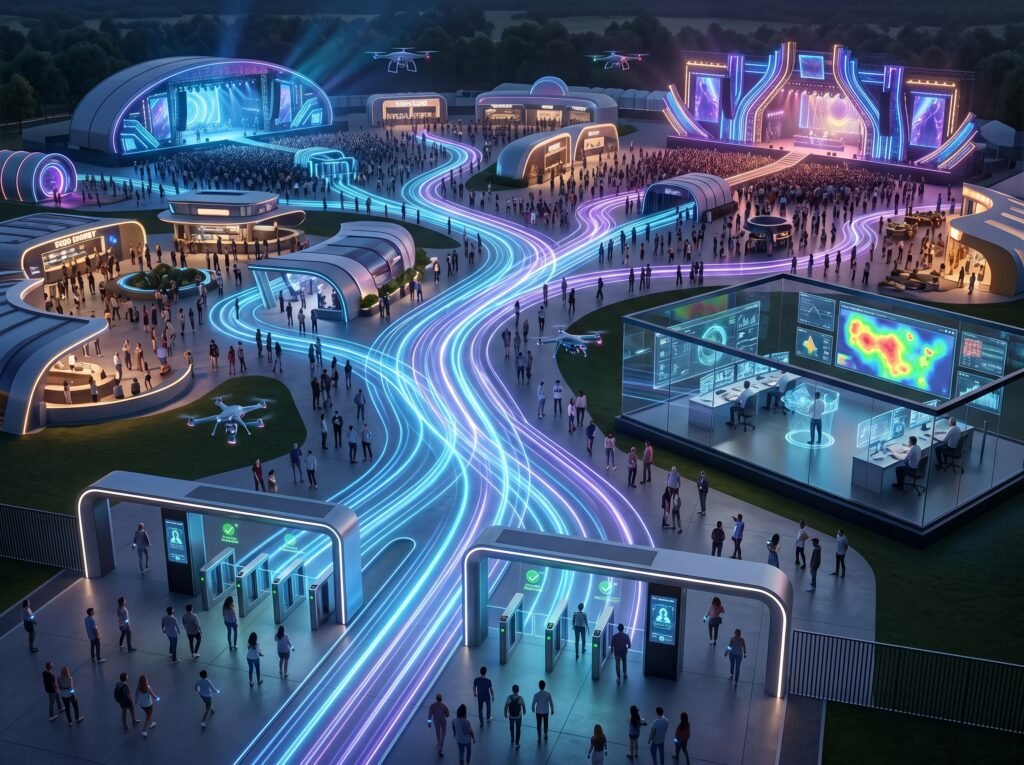
How Advanced Event Technologies Are Transforming Crowd Management, Payments, Security, and the Festival Experience
Introduction
Modern music and cultural festivals have evolved into temporary smart cities.
What was once a collection of stages, food vendors, and security barriers has become a highly connected ecosystem powered by artificial intelligence, real-time analytics, biometric authentication, cashless payment systems, and advanced crowd management technologies. Today’s largest festivals routinely host tens of thousands—and sometimes hundreds of thousands—of attendees across sprawling venues that operate continuously for days.
Managing these massive gatherings presents extraordinary logistical challenges. Organizers must move crowds safely, process attendees quickly, facilitate purchases efficiently, respond to emergencies instantly, and maintain positive experiences despite unpredictable conditions. Even minor operational failures can lead to long queues, frustrated attendees, safety concerns, and significant financial losses.
To address these challenges, festival operators are embracing a new generation of technologies designed to create what many industry professionals call a “frictionless festival experience.” The objective is simple: remove barriers that interrupt attendee enjoyment while improving safety, operational efficiency, and business performance.
From biometric ticketing systems that eliminate entry queues to AI-powered crowd monitoring platforms capable of identifying congestion before it becomes dangerous, technology is becoming one of the most important components of modern festival management.
This article explores the innovations powering today’s most sophisticated festivals and examines how organizers are using technology to keep crowds moving, transactions flowing, and chaos under control.
The Challenge of Managing Festival Crowds
Unlike stadium events or conferences, festivals present unique operational complexities.
Attendees are constantly moving between:
- Multiple stages
- Food courts
- Retail vendors
- Camping areas
- Transportation hubs
- Restrooms
- Entertainment zones
Crowd patterns shift throughout the day based on:
- Performance schedules
- Weather conditions
- Venue layouts
- Social trends
- Emergency situations
Organizers must monitor and respond to these dynamics in real time.
The larger the event becomes, the more critical technology becomes to maintaining order and ensuring positive attendee experiences.
The Evolution of the Smart Festival
Today’s leading festivals increasingly resemble technology platforms rather than traditional events.
Many now integrate:
- RFID wearables
- Mobile applications
- AI analytics systems
- Smart sensors
- Computer vision platforms
- Biometric access controls
- Real-time operational dashboards
These systems continuously collect and analyze data, helping organizers make informed decisions throughout the event.
The result is a festival environment that can adapt dynamically to changing conditions.
Biometric Ticketing: Eliminating the Entry Queue
One of the biggest pain points at any festival is arrival.
Long entry lines create frustration, congestion, and operational inefficiencies.
To address this challenge, many organizers are exploring biometric ticketing solutions.
How Biometric Ticketing Works
Attendees complete identity verification before arriving at the event.
This may involve:
- Photo registration
- Identity confirmation
- Secure credential creation
Upon arrival, facial recognition systems compare live images against verified attendee records.
If a match is confirmed, entry is granted automatically.
The attendee becomes the ticket.
Benefits of Biometric Entry
Biometric systems offer several advantages.
Faster Processing
Verification can occur in seconds.
Reduced Staffing Requirements
Automation minimizes manual checks.
Enhanced Security
Biometric credentials are difficult to duplicate or transfer.
Fraud Prevention
Counterfeit tickets become significantly harder to use.
For high-capacity festivals, these efficiency gains can dramatically improve attendee satisfaction.
Smart Ticketing Beyond Biometrics
Not all festivals use facial recognition systems.
Many rely on advanced digital ticketing platforms featuring:
- Dynamic QR codes
- Encrypted credentials
- NFC technology
- Mobile wallet integration
These systems reduce fraud while improving convenience.
Unlike static tickets, encrypted digital credentials can update in real time and provide additional layers of security.
RFID Wristbands: The Festival Operating System
Perhaps no technology has had a greater impact on modern festivals than RFID wristbands.
These wearable devices have become central to the attendee experience.
An RFID wristband can function as:
- An entry credential
- A payment method
- A networking tool
- A loyalty mechanism
- A data collection device
All within a single wearable form factor.
Cashless Payments and Faster Transactions
Cashless ecosystems have become standard at many major festivals.
Instead of carrying cash or credit cards, attendees load funds onto RFID wristbands or mobile wallets.
Purchases require only a quick tap.
Benefits include:
- Faster transaction times
- Shorter vendor lines
- Improved convenience
- Reduced theft risk
- Higher spending rates
For organizers, cashless systems also provide valuable operational insights.
Why Festivals Are Moving Away From Cash
Cash handling creates numerous challenges.
These include:
- Security risks
- Counting errors
- Theft concerns
- Longer transaction times
Digital payment systems eliminate many of these problems while creating smoother attendee experiences.
Research across the events industry consistently shows that frictionless payment systems often increase per-capita spending.
When purchases become easier, attendees tend to buy more.
Real-Time Crowd Monitoring
Crowd management remains one of the most important safety responsibilities for festival organizers.
Historically, crowd monitoring relied heavily on:
- Security personnel
- CCTV observation
- Radio communication
- Manual reporting
Today, AI-powered systems are adding new capabilities.
Computer Vision and Crowd Analytics
Advanced camera networks can now analyze crowd behavior automatically.
Using computer vision and machine learning, these systems can monitor:
- Crowd density
- Movement patterns
- Congestion levels
- Queue formation
- Restricted area access
This information helps operators identify potential issues before they escalate.
Automated Crowd-Sentiment Analysis
One of the most fascinating emerging applications involves crowd-sentiment analysis.
AI systems can evaluate environmental indicators to assess audience mood and engagement.
Inputs may include:
- Crowd movement patterns
- Behavioral indicators
- Facial expression analysis (where legally permitted)
- Audio levels
- Social media activity
The goal is not to monitor individuals but to understand crowd dynamics at scale.
Organizers can use these insights to optimize operations and improve attendee experiences.
Predicting Congestion Before It Happens
Traditional crowd management is reactive.
Problems are addressed after they appear.
Modern analytics platforms increasingly enable predictive management.
By analyzing:
- Historical attendance data
- Real-time movement patterns
- Performance schedules
- Venue conditions
AI systems can forecast potential congestion points.
Organizers can then:
- Redirect traffic
- Open additional routes
- Deploy staff proactively
- Adjust operational plans
before bottlenecks develop.
Smart Venue Mapping and Navigation
Large festivals can be difficult to navigate.
Attendees often struggle to locate:
- Stages
- Vendors
- Restrooms
- Medical stations
- Transportation hubs
Mobile event apps are helping solve this challenge.
Many now include:
- Interactive maps
- Real-time navigation
- Crowd density indicators
- Personalized recommendations
This reduces confusion while improving attendee flow.
Festival Apps as Digital Command Centers
Modern festival apps have evolved into comprehensive experience platforms.
Features commonly include:
Personalized Schedules
Attendees can build customized itineraries.
Real-Time Alerts
Organizers can communicate instantly.
Emergency Notifications
Critical information can be distributed quickly.
Social Features
Attendees can connect with friends and communities.
Interactive Engagement
Polls, games, and activations increase participation.
These capabilities improve both attendee satisfaction and operational responsiveness.
Drones and Aerial Monitoring
Many large festivals are beginning to incorporate drone technology into security and operational strategies.
Drones provide:
- Aerial visibility
- Rapid situational awareness
- Crowd monitoring capabilities
- Infrastructure inspections
They can cover large areas more efficiently than ground-based personnel.
In emergency situations, this visibility can be particularly valuable.
Smart Security Systems
Security technology is becoming increasingly sophisticated.
Modern systems may integrate:
- Facial recognition
- Threat detection algorithms
- License plate recognition
- AI surveillance tools
- Access control platforms
These technologies help security teams identify risks while reducing unnecessary disruptions for attendees.
The objective is to increase safety without creating excessive friction.
Internet of Things (IoT) and Festival Operations
The Internet of Things is quietly transforming festival management.
Connected sensors can monitor:
- Power systems
- Water infrastructure
- Waste levels
- Environmental conditions
- Equipment performance
Operators receive real-time updates that support proactive maintenance and operational decision-making.
This reduces the likelihood of unexpected disruptions.
Sustainability Through Technology
Technology is also helping festivals become more environmentally responsible.
Examples include:
Digital Ticketing
Reduces paper waste.
Smart Waste Management
Sensors optimize collection schedules.
Energy Monitoring
Improves efficiency and reduces consumption.
Cashless Transactions
Minimize physical resource requirements.
As sustainability becomes a growing priority, these technologies are becoming increasingly important.
The Rise of the Festival Control Center
Many major events now operate centralized command centers.
These facilities combine data from multiple systems, including:
- Ticketing platforms
- Crowd analytics tools
- Security systems
- Payment networks
- Environmental sensors
Operators gain a comprehensive view of festival activity in real time.
This integrated approach enables faster, more informed decision-making.
Challenges and Ethical Considerations
While these technologies offer significant benefits, they also raise important questions.
Key considerations include:
Privacy
How is attendee data collected and used?
Security
How are digital credentials protected?
Transparency
Do attendees understand how systems operate?
Accessibility
Can all participants engage effectively with technology-enabled experiences?
Responsible implementation is essential for maintaining trust.
The Future of Frictionless Festivals
The next generation of festivals will likely become even more intelligent and interconnected.
Emerging innovations include:
- AI-powered operational assistants
- Fully biometric entry systems
- Predictive crowd management
- Digital twins of festival sites
- Augmented reality navigation
- Hyper-personalized attendee journeys
As these technologies mature, festival experiences will become increasingly seamless, efficient, and responsive.
The ultimate goal is not simply to add technology but to make technology nearly invisible.
When implemented successfully, attendees spend less time dealing with logistics and more time enjoying the experience.
Conclusion
The modern festival is no longer just an entertainment venue—it is a sophisticated technology ecosystem designed to manage people, data, infrastructure, and experiences at an extraordinary scale. From biometric ticketing and RFID wristbands to AI-powered crowd analytics and real-time operational dashboards, technology is transforming how organizers deliver safe, efficient, and enjoyable events.
These innovations are eliminating many of the traditional pain points associated with large gatherings. Long entry queues are being replaced by frictionless authentication systems. Cash transactions are giving way to seamless digital payments. Reactive crowd management is evolving into predictive operational intelligence. Meanwhile, attendees benefit from smoother journeys, personalized experiences, and greater convenience.
As festivals continue to grow in size and complexity, the role of technology will only become more significant. The most successful events of the future will be those that use innovation not merely to impress audiences, but to remove friction entirely—creating environments where crowds move effortlessly, transactions happen instantly, and the focus remains exactly where it belongs: on the experience itself.