
 By
By
Introduction
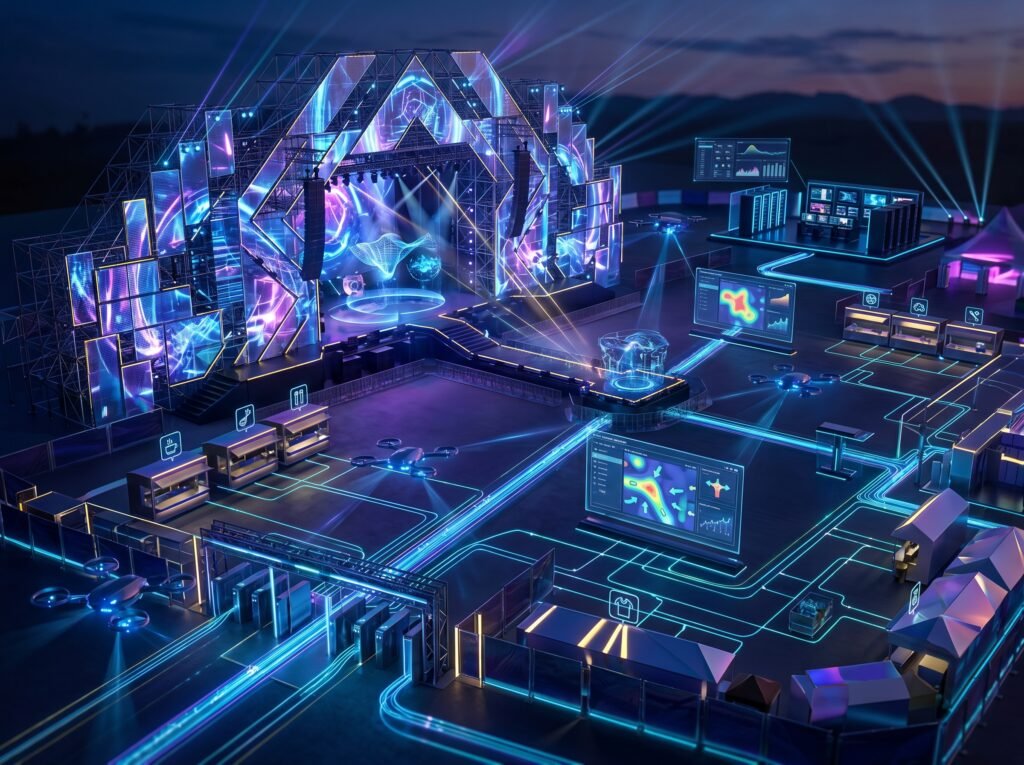
Imagine being able to walk through a concert stage before a single piece of equipment arrives on-site. Picture testing lighting effects, evaluating audience sightlines, positioning cameras, checking rigging safety, and identifying potential bottlenecks weeks before construction begins. Now imagine making design changes instantly—without moving a single truss, screen, speaker, or spotlight in the real world.
This is the promise of digital twin technology.
Originally developed for manufacturing, engineering, and aerospace applications, digital twins have rapidly emerged as one of the most powerful tools in modern event production. Today, event organizers, production companies, venue operators, architects, and stage designers are using highly detailed virtual replicas of physical environments to plan, test, and optimize complex event setups long before crews arrive at the venue.
For massive stadium concerts, international festivals, esports tournaments, sporting events, and large-scale corporate productions, digital twins are helping teams coordinate thousands of moving parts with unprecedented precision. They reduce costly errors, improve collaboration, minimize material waste, and allow stakeholders to make informed decisions based on accurate simulations rather than assumptions.
As events become increasingly sophisticated and production budgets continue to rise, digital twins are changing the way stages are designed, built, and managed. What was once a niche engineering concept is quickly becoming a critical component of event technology strategy.
This article explores what digital twins are, how they work, why they are transforming stage design, and how they are helping event professionals create safer, smarter, and more sustainable productions.
Understanding the Digital Twin Concept
At its core, a digital twin is a virtual replica of a physical object, environment, system, or process.
Unlike a simple 3D model, a digital twin is designed to simulate real-world conditions and behavior.
It can represent:
- Stadiums
- Arenas
- Convention centers
- Concert stages
- Festival grounds
- Lighting systems
- Audio systems
- Crowd movement
- Equipment layouts
The virtual environment mirrors physical conditions as accurately as possible.
This allows teams to test scenarios, identify problems, and evaluate design decisions before implementing them in reality.
Digital Twins vs. Traditional 3D Models
Many people assume digital twins are simply advanced 3D renderings.
While both technologies share similarities, important differences exist.
Traditional 3D Models
Traditional models primarily provide visual representation.
They help stakeholders understand:
- Appearance
- Dimensions
- Layouts
- Design concepts
However, they typically do not simulate behavior.
Digital Twins
Digital twins go much further.
They can incorporate:
- Real-world measurements
- Environmental data
- Equipment specifications
- Performance metrics
- Operational workflows
This transforms a static visualization into a dynamic planning environment.
Instead of merely seeing a stage design, planners can understand how it will function.
Why Stage Design Has Become So Complex
Modern live events are dramatically more sophisticated than they were even a decade ago.
Today’s productions often include:
- Massive LED screens
- Automated lighting systems
- Complex rigging structures
- Projection mapping
- Drone integration
- Special effects
- Immersive audience experiences
A single stadium show may involve hundreds of technical components that must work together seamlessly.
Even minor design errors can result in:
- Delays
- Safety risks
- Equipment conflicts
- Budget overruns
- Reduced audience satisfaction
As production complexity increases, traditional planning methods become less effective.
Digital twins provide a solution.
Creating a Digital Twin of a Venue
The first step in building a digital twin involves capturing accurate information about the physical environment.
This process often uses technologies such as:
Laser Scanning
Laser scanners capture millions of measurements to create highly detailed spatial maps.
LiDAR Technology
LiDAR systems generate precise three-dimensional representations of venues.
Drone Mapping
Aerial scanning helps model large outdoor festival sites and stadium complexes.
Architectural Data
Existing venue blueprints can be integrated into the digital model.
The result is an accurate virtual representation of the venue.
Designing Stages in a Virtual Environment
Once the venue has been digitized, production teams can begin building virtual stage designs.
This process allows planners to test countless configurations before construction begins.
Examples include:
- Stage placement
- Screen positioning
- Lighting arrangements
- Speaker locations
- Camera angles
- Audience layouts
Design modifications can be made instantly.
This flexibility dramatically improves planning efficiency.
Eliminating Spatial Errors Before They Happen
One of the biggest advantages of digital twins is their ability to identify spatial conflicts.
In large productions, equipment often competes for limited space.
Potential issues include:
- Lighting fixtures blocking video screens
- Cameras obstructing audience views
- Rigging conflicts
- Equipment clearance problems
- Emergency access restrictions
Historically, many of these issues were discovered during setup.
At that stage, corrections are often expensive and time-consuming.
Digital twins allow teams to detect and resolve problems virtually.
Improving Sightline Analysis
Audience experience depends heavily on visibility.
A spectacular stage design means little if attendees cannot see key elements of the show.
Digital twins allow planners to evaluate:
- Sightlines from every seating section
- Obstructions caused by equipment
- Screen visibility
- Stage elevation requirements
Designers can optimize layouts to ensure strong viewing experiences throughout the venue.
For stadium events with tens of thousands of attendees, this capability is invaluable.
Testing Lighting and Visual Effects
Lighting is one of the most critical elements of modern stage production.
Digital twins enable lighting designers to experiment within virtual environments before physical installation.
Teams can evaluate:
- Beam positioning
- Color effects
- Visual impact
- Coverage areas
- Timing sequences
This reduces setup time while improving creative outcomes.
Audio Simulation and Acoustic Planning
Sound quality varies significantly depending on venue characteristics.
Digital twins can model acoustic behavior within:
- Arenas
- Stadiums
- Theaters
- Outdoor venues
Audio engineers can test:
- Speaker placement
- Sound coverage
- Delay timing
- Echo behavior
- Audience listening experiences
These simulations help optimize audio performance before equipment deployment.
Coordinating Massive Multi-Team Productions
Large-scale events involve numerous stakeholders.
These may include:
- Production managers
- Stage designers
- Lighting teams
- Audio engineers
- Safety officers
- Venue operators
- Sponsors
- Broadcast partners
Historically, communication challenges have contributed to project delays.
Digital twins provide a shared environment where all stakeholders can review plans collaboratively.
This improves alignment and decision-making.
Supporting Remote Collaboration
Modern event production often involves teams working across multiple locations.
Digital twin platforms enable remote stakeholders to:
- Explore venue layouts
- Review designs
- Suggest modifications
- Conduct planning meetings
without traveling to the venue.
This capability became especially valuable during periods of restricted travel and continues to support global collaboration today.
Reducing Prototype Waste
Traditional stage design frequently relies on physical mockups and prototypes.
These processes consume:
- Materials
- Labor
- Transportation resources
- Storage space
Digital twins allow teams to test ideas virtually instead.
Benefits include:
- Less material waste
- Reduced transportation requirements
- Lower production costs
- Faster design iterations
This contributes to both financial efficiency and sustainability goals.
Sustainability Benefits of Digital Twins
Environmental considerations are becoming increasingly important within the events industry.
Digital twins support sustainability through:
Reduced Rework
Fewer design mistakes mean fewer wasted materials.
Lower Transportation Needs
Virtual reviews reduce site visits and prototype shipments.
Improved Resource Planning
Accurate simulations help minimize unnecessary equipment deployment.
Better Energy Optimization
Systems can be tested for efficiency before installation.
These advantages align with broader efforts to create greener events.
Real-Time Monitoring During Live Events
The most advanced digital twins continue functioning after construction is complete.
They can integrate real-time operational data from:
- Sensors
- IoT devices
- Security systems
- Environmental monitoring tools
This allows operators to monitor event conditions dynamically.
Examples include:
- Crowd density
- Equipment performance
- Energy consumption
- Environmental conditions
The digital twin becomes a live operational dashboard.
Applications Beyond Concerts
While digital twins are particularly valuable for stage design, their applications extend far beyond concerts.
They are increasingly used for:
Sports Events
Managing venue operations and fan experiences.
Festivals
Planning layouts, logistics, and crowd management.
Trade Shows
Optimizing exhibitor placement and visitor flow.
Corporate Events
Designing immersive environments and production setups.
Esports Tournaments
Coordinating complex broadcast and audience experiences.
The technology is becoming relevant across nearly every segment of the events industry.
Challenges to Adoption
Despite its advantages, digital twin technology is not without challenges.
Initial Investment
Creating highly detailed digital environments requires specialized tools and expertise.
Data Requirements
Accurate simulations depend on accurate information.
Training Needs
Teams must learn new workflows and technologies.
Integration Complexity
Combining data from multiple systems can be challenging.
However, as software becomes more accessible, these barriers are gradually decreasing.
The Future of Digital Twins in Event Production
The next generation of digital twins will likely become even more powerful through integration with:
- Artificial Intelligence
- Augmented Reality
- Virtual Reality
- Real-time sensor networks
- Predictive analytics
Future systems may automatically recommend design improvements, identify risks, forecast crowd behavior, and optimize resource allocation.
As computing power increases, digital twins will become more detailed, more dynamic, and more widely adopted.
Conclusion
Digital twins are fundamentally changing how event professionals design, plan, and manage complex productions. By creating accurate virtual replicas of venues and stages, planners can test ideas, identify problems, optimize layouts, and coordinate stakeholders long before construction begins.
For massive stadium concerts, festivals, sporting events, and corporate productions, the benefits are substantial. Digital twins reduce costly errors, improve safety, enhance collaboration, streamline logistics, and minimize environmental waste. What once required expensive physical prototypes and on-site trial-and-error can now be accomplished within sophisticated virtual environments.
As event experiences become increasingly ambitious and technology-driven, digital twins are emerging as one of the most valuable tools in the production toolkit. They allow teams to move from reactive problem-solving to proactive planning, creating smarter, more efficient, and more sustainable events.
In many ways, the future of stage design is being built twice—first in the digital world and then in the physical one. And thanks to digital twins, that first build is becoming one of the most important steps in the entire production process.