
 By
By
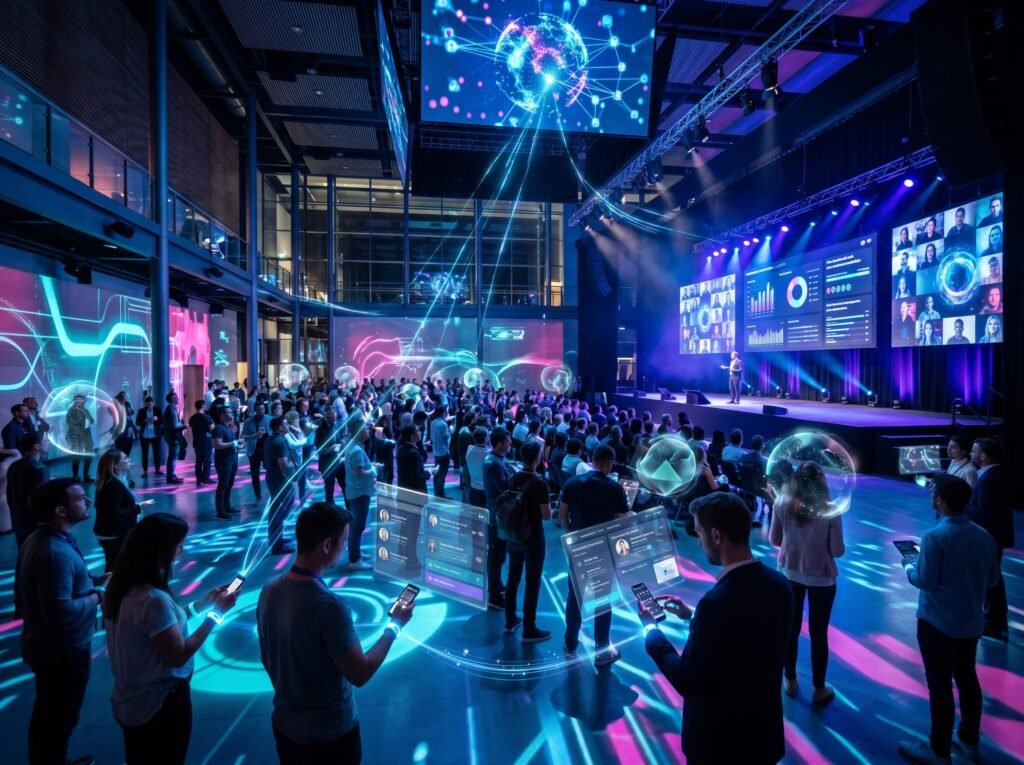
How Wearables, Interactive Spaces, and Real-Time Connectivity Are Redefining the Future of Events
Introduction
For years, the events industry treated physical and virtual experiences as separate worlds.
An in-person conference meant traveling to a venue, sitting in sessions, meeting exhibitors, and networking face-to-face. A virtual event, meanwhile, typically involved watching presentations through a laptop screen, participating in chat rooms, and occasionally joining video discussions.
Then came the rise of hybrid events—a model designed to serve both audiences simultaneously. While hybrid events solved accessibility challenges, many early implementations simply added a livestream to a physical gathering. Remote attendees often felt like passive observers rather than active participants, while those attending in person experienced little interaction with the online audience.
Today, the industry is moving beyond basic hybrid models toward something far more ambitious: phygital events.
The term “phygital” combines physical and digital, describing experiences where technology actively connects in-person and remote participants in real time. Rather than operating as parallel experiences, the physical and digital environments become deeply interconnected, creating a shared event ecosystem where everyone can contribute, interact, and engage regardless of location.
Powered by technologies such as RFID wearables, interactive event apps, augmented reality, projection mapping, artificial intelligence, real-time data analytics, and immersive digital environments, phygital events are transforming how audiences experience conferences, festivals, trade shows, sporting events, and brand activations.
In this new model, attendees are no longer divided into “onsite” and “virtual” categories. Instead, they become part of a unified experience that blends the best aspects of both worlds.
What Exactly Is a Phygital Event?
A phygital event is more than a physical gathering with a livestream.
It is an integrated experience where digital technologies enhance, extend, and connect the physical environment.
In a phygital event:
- Physical attendees interact with digital systems.
- Remote participants influence real-world experiences.
- Data flows between both environments.
- Engagement occurs across multiple channels simultaneously.
The objective is to remove the barriers between physical and digital participation.
Whether someone attends from a conference hall or from another continent, they can contribute meaningfully to the event experience.
Why Traditional Hybrid Events Often Fall Short
The first generation of hybrid events focused primarily on content delivery.
Remote attendees could:
- Watch presentations
- Access recordings
- Participate in chat discussions
- Submit questions
While useful, these features often failed to replicate the energy and spontaneity of live events.
Common complaints included:
- Limited networking opportunities
- Passive viewing experiences
- Minimal interaction with in-person attendees
- Reduced engagement levels
In many cases, virtual participants felt like spectators rather than attendees.
Phygital events aim to solve this problem.
The Technology Driving Phygital Experiences
Several innovations are making phygital experiences possible.
The most successful implementations combine multiple technologies into a seamless ecosystem.
Key technologies include:
- RFID wearables
- NFC credentials
- Interactive mobile applications
- Projection mapping
- Artificial intelligence
- Augmented reality
- Real-time analytics
- Spatial computing
- IoT-enabled venues
Together, these tools create experiences that blur the line between physical and digital participation.
RFID Wearables: The Digital Bridge Between Attendees and Events
One of the most important components of modern phygital experiences is wearable technology.
RFID (Radio Frequency Identification) wristbands are increasingly used at conferences, festivals, exhibitions, and sporting events.
Unlike traditional event badges, RFID wearables act as intelligent digital identities.
They can enable:
- Venue access
- Session check-ins
- Cashless payments
- Interactive experiences
- Networking exchanges
- Personalized recommendations
Every interaction generates valuable event data.
This data can then be used to personalize experiences for attendees.
Turning Physical Actions Into Digital Experiences
Consider a conference attendee walking into a session room.
An RFID wristband automatically:
- Registers attendance
- Updates the attendee profile
- Unlocks relevant digital content
- Notifies remote participants about session activity
Similarly, a remote attendee could react to a presentation in real time, with those reactions appearing on venue displays.
Physical and digital experiences become interconnected rather than isolated.
Interactive Event Apps as Experience Hubs
Modern event apps have evolved far beyond schedule management tools.
In phygital environments, mobile applications serve as central control systems for attendee engagement.
Participants can:
- Schedule meetings
- Join live discussions
- Access personalized content
- Participate in polls
- Connect with sponsors
- Exchange digital contact information
Importantly, these interactions occur regardless of physical location.
An attendee at the venue can communicate directly with a remote participant thousands of miles away.
Real-Time Audience Interaction
One of the most exciting aspects of phygital events is synchronized audience participation.
Imagine a keynote presentation where:
- In-person attendees vote through RFID-enabled devices.
- Remote participants vote through a mobile app.
- Results appear instantly on massive venue screens.
Everyone contributes equally.
The audience becomes part of the experience rather than merely consuming content.
This creates a stronger sense of shared participation.
Projection Mapping: Transforming Physical Spaces Into Interactive Environments
Projection mapping is another technology helping redefine phygital events.
Unlike traditional projections, projection mapping turns physical surfaces into dynamic digital canvases.
Common applications include:
- Interactive floors
- Building facades
- Stage environments
- Exhibition spaces
The result is a highly immersive experience that responds to audience behavior.
Interactive Floors and Shared Experiences
Imagine walking through a conference venue where the floor reacts to movement.
As attendees step forward:
- Visual effects follow them.
- Information appears dynamically.
- Audience participation triggers changes in the environment.
Now imagine remote attendees influencing those same visuals through a digital platform.
A participant watching from home can contribute to the experience occurring inside the venue.
This level of interaction exemplifies the phygital philosophy.
Breaking Down Networking Barriers
Networking remains one of the biggest challenges for virtual event participants.
Phygital events address this through technology-enabled matchmaking.
AI-powered systems analyze:
- Professional backgrounds
- Interests
- Business objectives
- Session participation
to recommend relevant connections.
The result is a networking ecosystem that includes both physical and remote attendees.
A professional attending from London can be matched with someone sitting in the venue in Singapore.
Technology removes geographical limitations.
AI-Powered Matchmaking and Intelligent Connections
Artificial intelligence plays a crucial role in phygital networking.
Modern platforms can:
- Suggest introductions
- Schedule meetings
- Recommend sessions
- Identify common interests
- Facilitate collaboration opportunities
This creates more intentional networking experiences.
Rather than relying on chance encounters, attendees connect based on genuine compatibility.
The result is often stronger business outcomes and higher networking satisfaction.
Creating Shared Event Moments
One reason physical events remain valuable is the sense of collective experience.
People enjoy feeling part of something larger than themselves.
Phygital technologies help extend that feeling to remote audiences.
Examples include:
- Shared live challenges
- Interactive games
- Real-time audience voting
- Collaborative digital art installations
- Global discussion forums
Remote attendees become active participants in the event narrative.
Data as the Engine of Personalization
Phygital events generate enormous amounts of data.
Every interaction provides insight into attendee behavior.
Organizers can track:
- Session attendance
- Networking activity
- Content engagement
- Movement patterns
- Audience preferences
This information enables highly personalized experiences.
Instead of offering the same journey to every participant, events can adapt dynamically to individual interests.
Benefits for Sponsors and Exhibitors
Sponsors are increasingly embracing phygital models because they offer deeper engagement opportunities.
Traditional sponsorship often focuses on visibility.
Phygital sponsorship focuses on interaction.
Brands can:
- Create digital activations
- Engage remote audiences
- Deliver personalized content
- Measure engagement in real time
- Collect actionable insights
This provides significantly more value than traditional advertising alone.
The Role of Augmented Reality
Augmented reality (AR) is becoming another key component of phygital experiences.
Using smartphones or smart glasses, attendees can access digital content layered over physical environments.
Examples include:
- Interactive exhibitor information
- Product visualizations
- Gamified event experiences
- Navigation assistance
- Real-time translation
AR enhances physical environments while maintaining a strong connection to digital content.
Beyond Conferences: Phygital Applications Across Event Types
The phygital model extends well beyond business conferences.
Applications include:
Music Festivals
RFID wearables, interactive installations, and remote fan participation.
Sporting Events
Real-time fan engagement across stadium and digital audiences.
Trade Shows
Integrated exhibitor experiences connecting buyers worldwide.
Product Launches
Simultaneous physical demonstrations and virtual interaction.
Cultural Festivals
Shared participation between local attendees and global audiences.
The possibilities continue expanding as technology evolves.
Challenges of Phygital Event Design
Despite its advantages, phygital event execution can be complex.
Challenges include:
Technology Integration
Multiple systems must work together seamlessly.
User Adoption
Attendees must understand how to engage with new technologies.
Infrastructure Requirements
Reliable connectivity and platform performance are essential.
Privacy Considerations
Data collection requires transparency and responsible management.
Organizers must carefully balance innovation with usability.
The Future of Phygital Experiences
The future of events is unlikely to be exclusively physical or entirely virtual.
Instead, the industry is moving toward experiences that blend both worlds seamlessly.
Emerging innovations may include:
- AI event companions
- Digital twins of venues
- Mixed reality networking
- Holographic participation
- Wearable biometric experiences
- Persistent event communities
As technologies mature, attendees will increasingly expect events to provide flexible, connected, and personalized experiences regardless of location.
Conclusion
Phygital events represent the next evolution of event design. Moving far beyond the simplistic model of “a live event with a webcast,” they create deeply integrated experiences where physical and digital audiences interact as part of the same ecosystem.
Through technologies such as RFID wearables, projection mapping, interactive event apps, AI-powered matchmaking, augmented reality, and real-time engagement platforms, organizers can create environments where participation is no longer limited by geography. Remote attendees become contributors rather than spectators, while in-person participants gain access to richer, more personalized experiences.
The result is a new kind of event—one that combines the energy and authenticity of face-to-face interaction with the accessibility, intelligence, and scalability of digital technology.
As attendee expectations continue to evolve, the question for event organizers will no longer be whether to choose physical or digital. The future belongs to those who can master the art of combining both into a seamless, engaging, and truly phygital experience.